
The first thing CreatStrat found was an angle we'd never advertised despite it appearing repeatedly in our customer reviews. They turned it into several concepts, we launched them, and two became some of our strongest ads. That paid for the subscription many times over.
 Daniel W. · CreatStrat customer
Look at the first sentence again. The angle wasn't hidden. It sat in customer reviews the brand already had, repeatedly, and it had never become one of their ad angles.
If your reviews have only ever been a star average under the product or a screenshot in a testimonial ad, you've been using them as proof. Read them as research first. Look for the situation the customer was in, the objection that almost stopped them, and the words they used. Then write the hook in those words.
The table below does that, one review line per row.
What is a customer avatar?
A customer avatar is a situation, not a demographic: who is buying, what just happened, and what they were afraid would go wrong. It's the specific person an ad talks to, described closely enough that you know what to say in the first line.
A persona sheet (an age range, an income band, some hobbies) fails that test. None of it tells you what to say.
A review fills the gap. It tells you what just happened (a move, a new dog, a gift with a deadline), what the buyer feared would go wrong, and how they put it, in words your team wouldn't have chosen.
In a brief, the avatar is the first field, and it shapes the next three: the awareness level the ad opens at, the angle, and the hook. The production-ready ad brief post covers each field. Once you have several avatars, an audience gaps audit shows which ones no live ad is talking to.
The review-to-avatar-to-hook table
Four columns, left to right: the customer's words, copied verbatim; the situation behind them, which is the avatar; the objection or desire; and the hook. Skip straight to the hook and marketer language creeps back in.
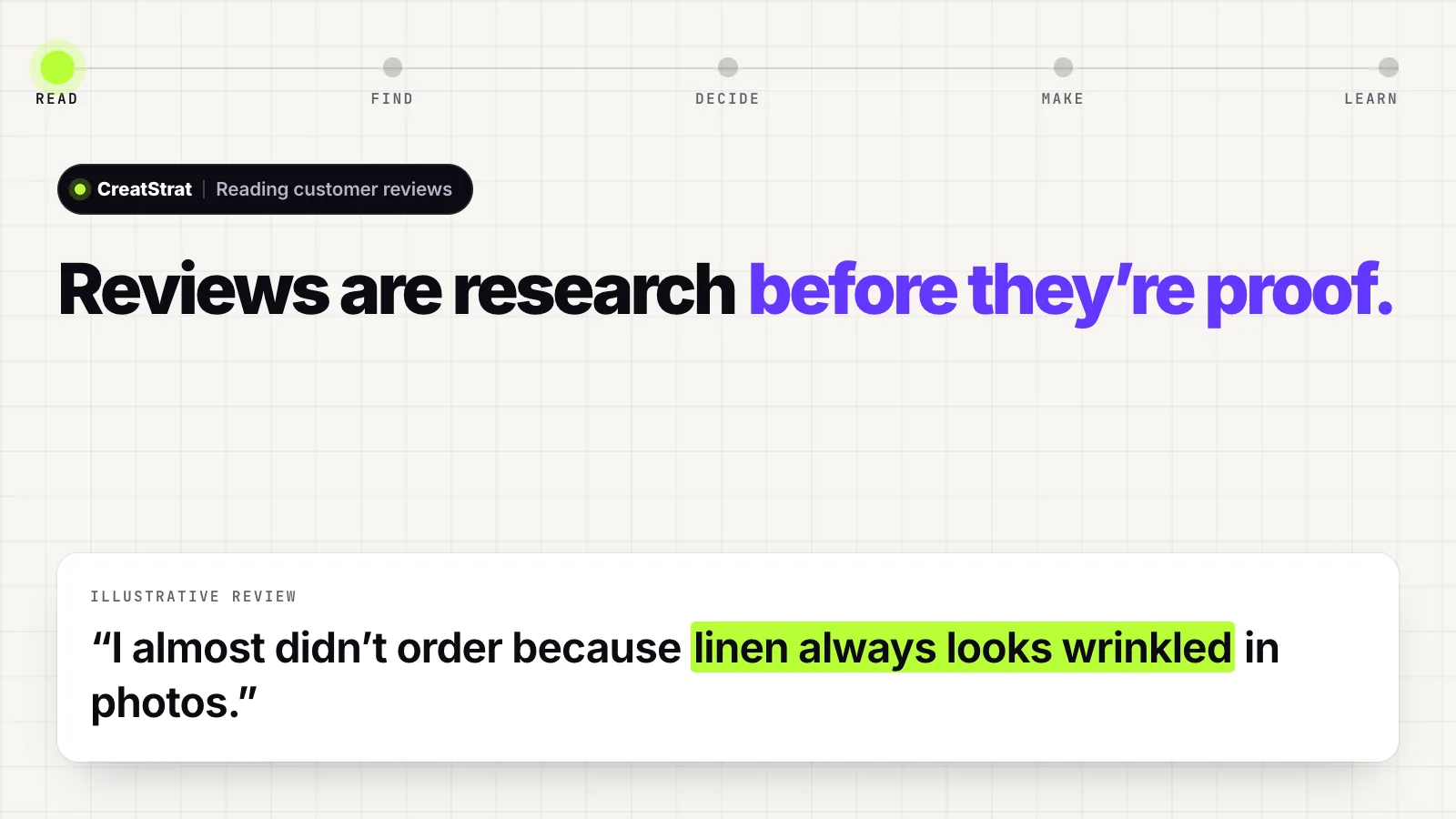
A review is research before it is proof. Read it for the customer's situation, the objection they nearly didn't get past, and the words they used, then write the hook in those words.
Illustrative: example review lines written for this post, not real reviews.
| Customer's words (verbatim line) | Situation (the avatar) | Objection or desire | Hook |
|---|---|---|---|
| "The dog sleeps on it every night and the hair brushes right off." | Shares the bed with a dog and had stopped buying nice bedding | Desire: bedding that can live with the dog | "For beds the dog thinks are his. The hair brushes right off." |
| "I almost didn't order because linen always looks wrinkled in photos." | First-time linen buyer comparing it with crisp cotton | Objection: it will look messy | "Yes, linen wrinkles. Here's how that looks on a bed nobody made this morning." |
| "Switched from my old cotton set and the duvet finally stopped bunching inside the cover." | Replacing a worn set after years, fed up with one specific annoyance | Desire: a duvet that stays put | "Corner ties, so the duvet stops bunching inside the cover." |
| "Bought it for my sister's first apartment, then ordered one for myself." | Buying a gift for someone else's move | Objection: will they actually use it? | "The first-apartment gift you'll end up ordering for yourself." |
| "I thought it was overpriced until it got softer with every wash." | Skeptic who has bought and replaced cheap covers before | Objection: the price | "It costs more up front. It gets softer with every wash." |
Those five rows were built by hand. The Gap Scan does the same pass on your product page.
Free. 3 researched opportunities, 1 customer-avatar gap, and 1 example concept within 24 hours.
Read each row from the hook back to the first column. A good hook reuses the customer's noun and verb ("wrinkles", "bunching", "softer", "first apartment"), not the marketer's, and if you can't trace its key word to the first column, it came from your brand deck. The table gives you angles to test. It can't tell you which one will work.
How to read reviews: cluster by need, not by keyword
Two customers can describe the same need in words that share nothing. "It never slides around" and "I'm done wrestling the duvet back into place" are one complaint (two illustrative lines). Count keywords and you get two topics. Count needs and you get one. So before you count anything, tag each review line with the single need behind it, in a short label of your own.
“It never slides around.”
“I'm done wrestling the duvet back into place.”
One short label of your own, used for every line that asks for the same thing.
Count keywords and these two lines are two topics. Count needs and they are one.
Then watch for the frequency trap. Reviews repeat a few needs constantly, and those are usually the needs your ads already cover. Counting mentions finds the angle you already run.
Timoshenko and Hauser report, in the accepted manuscript of their 2019 Marketing Science paper, that the most frequent 10% of customer needs in an Amazon oral-care review sample appeared in 54% of informative sentences, while 17 needs appeared no more than 5 times.
The same paper shows how much reviews hold. Of 8,000 sentences sampled at random from 115,099 oral-care reviews (1996-2014), 52% contained at least one customer need, according to the same manuscript. In those 8,000 sentences, analysts found 8 needs that the study's professional customer interviews hadn't. At 12,000 sentences they had 91 of the 94 needs found across both methods, or 97% (Timoshenko and Hauser, 2019).
Keep the scope in view. It's one category, the reading was done by professional analysts, and the authors say they can't rule out self-selection problems in other categories. The study shows that reviews contain customer needs, rare ones included; it doesn't test this table or show that angles mined from reviews outperform other angles.
In practice: sort your tags by count, cross off every need a live ad already answers, and read the bottom third of the list on purpose. Check the top as well. The angle in Daniel W.'s review appeared repeatedly and still had never been advertised.
Which reviews should you read first?
Read 2-4 star reviews first for the trade-offs customers weighed, 1-star reviews for the objections that stopped them, and 5-star reviews for the words they used to describe what worked.
- 2-4 stars: these buyers kept the product and still name what it cost them, which is where trade-offs and near-miss objections show up.
- 1-star: the objection that won, once you set aside the reviews about a late parcel or a defect.
- 5-star: thin on analysis but full of the customer's own vocabulary, which is where the hook's words come from.
There's research behind starting in the middle. Across 1,587 Amazon reviews of six products, Mudambi and Schuff (MIS Quarterly, 2010) found that moderate ratings were judged more helpful than extreme ones for experience goods, and that review depth raised helpfulness.
Shoppers act on the middle too. Using sales data from three e-commerce sites, Maslowska, Malthouse and Bernritter (International Journal of Advertising, 2017) found that purchase probability rose with average rating up to about 4.2-4.5 stars and then fell. A perfect 5.0 wasn't the rating that sold best in their data.
Neither study tests ads. They're the reason the middle of your star range deserves your first hour.
Can you use competitor reviews?
Yes, as research. A competitor's reviews show what their customers wish the product did and which objections they raise that your product already answers. Read their 2-4 star reviews the way you read your own. When a need shows up that your product handles, add it to your table, then look for your own customers' words for it.
Don't quote competitor reviews in your ads. Those are another brand's customers describing another product, and the rules for putting any review into an ad are in the guardrails below. A need that a competitor's customers keep raising, and that no ad in your account answers, is one of the audience gaps worth briefing.
From hook to brief
Each row fills four fields of a brief: the avatar, the awareness level the ad opens at, the angle, and the hook. The rest of a production-ready ad brief (script or layout, visual direction, production notes, and Meta copy) builds on those four.
One row is one concept. Five hooks written for the same avatar and the same objection are one idea in five outfits. Claire M. described the difference after her first week:
We gave CreatStrat one product and within the first week had more genuinely different concepts to test than we'd produced internally in the previous month. The biggest difference wasn't just volume, the ads were based on different customer problems, objections and awareness levels rather than being cosmetic variations of the same concept.
 Claire M. · CreatStrat customer
Different customer problems, objections, and awareness levels are also what the concept census in 4 ideas, not 40 ads counts on a live account.
The table works by hand. Keeping it current as new reviews arrive is the harder part. CreatStrat is a software subscription that delivers finished ads every week. It researches your brand, customers, and market, plans the tests, writes the brief, and produces the finished statics, carousels, mashups, AI video, and AI UGC, each with its Meta copy, built from your own photos, footage, and customer language. Your creative strategist is built in. You launch the ads in your own account.
Two guardrails before a review becomes an ad
Mining reviews for angles is research. Two sets of rules apply once a review line heads into an ad.
Guardrail 1: turning a review line into a hook
Meta's ad policy bars ads that assert or imply a personal attribute (Meta Transparency Center, "Advertising Standards: Privacy violations and personal attributes"), so a review that mentions a condition can become a hook about the product, not a question that asks the reader about theirs.
Meta's Advertising Standards page (Meta Transparency Center, "Advertising Standards: Privacy violations and personal attributes") lists "physical or mental health (including medical conditions)" among those attributes, along with age and "vulnerable financial status". Its own examples draw the line. Prohibited: "Do you have diabetes?" and "Meet other seniors". Allowed: "Bulimia counseling available" and "Meet seniors". The review line stays your evidence; the hook talks about the product and the situation. The page's most recent changelog entry is dated June 26, 2024, so check the current version before you write hooks in a sensitive category.
Guardrail 2: putting the review itself into the ad
The FTC's Endorsement Guides say an endorsement "may not be presented out of context or reworded so as to distort in any way the endorser's opinion or experience with the product" (16 CFR 255.1(b)). When an ad uses a customer's endorsement about how the product performs, the FTC interprets it as a claim that the product is effective for that purpose, and an endorsement about a central attribute will likely be read as what customers generally achieve, unless you substantiate that it's typical or clearly disclose the results people should generally expect (16 CFR 255.2(a) and (b)). Separately, the FTC's Consumer Reviews and Testimonials rule, effective October 21, 2024, bars a business from writing or creating a review or testimonial that materially misrepresents whether the reviewer exists, whether they used the product, or their experience with it (16 CFR Part 465). AI and actor voices reading a review are covered in AI UGC or a real creator.
This is a pointer to the source text, not legal advice. Check your ads with your own counsel.
Frequently asked questions
How do I turn customer reviews into ad angles? Put review lines into a four-column table: the customer's words, their situation, the objection or desire behind them, and a hook written in their words. Each row becomes one concept. Start with the needs your live ads don't address yet.
Which customer reviews should I read first? Read 2-4 star reviews first, because they state trade-offs, then 1-star reviews for objections and 5-star reviews for the exact words customers use. Mudambi and Schuff (MIS Quarterly, 2010) found moderate ratings were judged more helpful than extreme ones for experience goods.
What is a customer avatar? A customer avatar is a situation, not a demographic: who is buying, what just happened, and what they were afraid would go wrong. Customer reviews supply all three in the customer's own words, which a persona sheet built on age and income can't.
Can I use competitor reviews to find ad angles? Yes, as research. Look for what a competitor's customers wish the product did and which objections your product answers, then write those as your own avatar and hook. Don't quote competitor reviews in your own ads.
Can I put a customer review in a Facebook ad? You can use real reviews, but the FTC's Endorsement Guides say an endorsement may not be presented out of context or reworded so it distorts the customer's experience (16 CFR 255.1(b)). That's a pointer to the source text, not legal advice.
Where to start
The quickest check is narrow: do your reviews hold an angle your ads have never used? Pull last quarter's 2-4 star reviews, tag the needs, and hold the list against your live ads. The Gap Scan runs that pass on a product page.
Free. 3 researched opportunities, 1 customer-avatar gap, and 1 example concept within 24 hours.
Want to see the app first? Book a demo →
Sources
- Timoshenko, A., & Hauser, J. R. (2019). Identifying customer needs from user-generated content. Marketing Science, 38(1), 1-20. https://doi.org/10.1287/mksc.2018.1123 (figures cited from the accepted manuscript, June 2018: https://hdl.handle.net/1721.1/122049)
- Mudambi, S. M., & Schuff, D. (2010). What makes a helpful online review? A study of customer reviews on Amazon.com. MIS Quarterly, 34(1), 185-200. https://doi.org/10.2307/20721420
- Maslowska, E., Malthouse, E. C., & Bernritter, S. F. (2017). Too good to be true: The role of online reviews' features in probability to buy. International Journal of Advertising, 36(1), 142-163. https://doi.org/10.1080/02650487.2016.1195622
- Federal Trade Commission. (2023, July 26). Guides Concerning the Use of Endorsements and Testimonials in Advertising. 88 FR 48092-48112; 16 CFR Part 255. https://www.federalregister.gov/documents/2023/07/26/2023-14795/guides-concerning-the-use-of-endorsements-and-testimonials-in-advertising (current section text: https://www.ecfr.gov/current/title-16/chapter-I/subchapter-B/part-255)
- Federal Trade Commission. (2024, August 22). Trade Regulation Rule on the Use of Consumer Reviews and Testimonials. 89 FR 68034-68079; 16 CFR Part 465. Effective 2024-10-21. https://www.federalregister.gov/documents/2024/08/22/2024-18519/trade-regulation-rule-on-the-use-of-consumer-reviews-and-testimonials
- Meta. Advertising Standards: Privacy violations and personal attributes. Meta Transparency Center. https://transparency.meta.com/policies/ad-standards/objectionable-content/privacy-violations-personal-attributes/