
Hook rate is the number people reach for when a video ad isn't working, and Meta's ad insights have no field for it. Meta doesn't define hook rate or hold rate. Both are formulas somebody built, and the versions in circulation disagree.
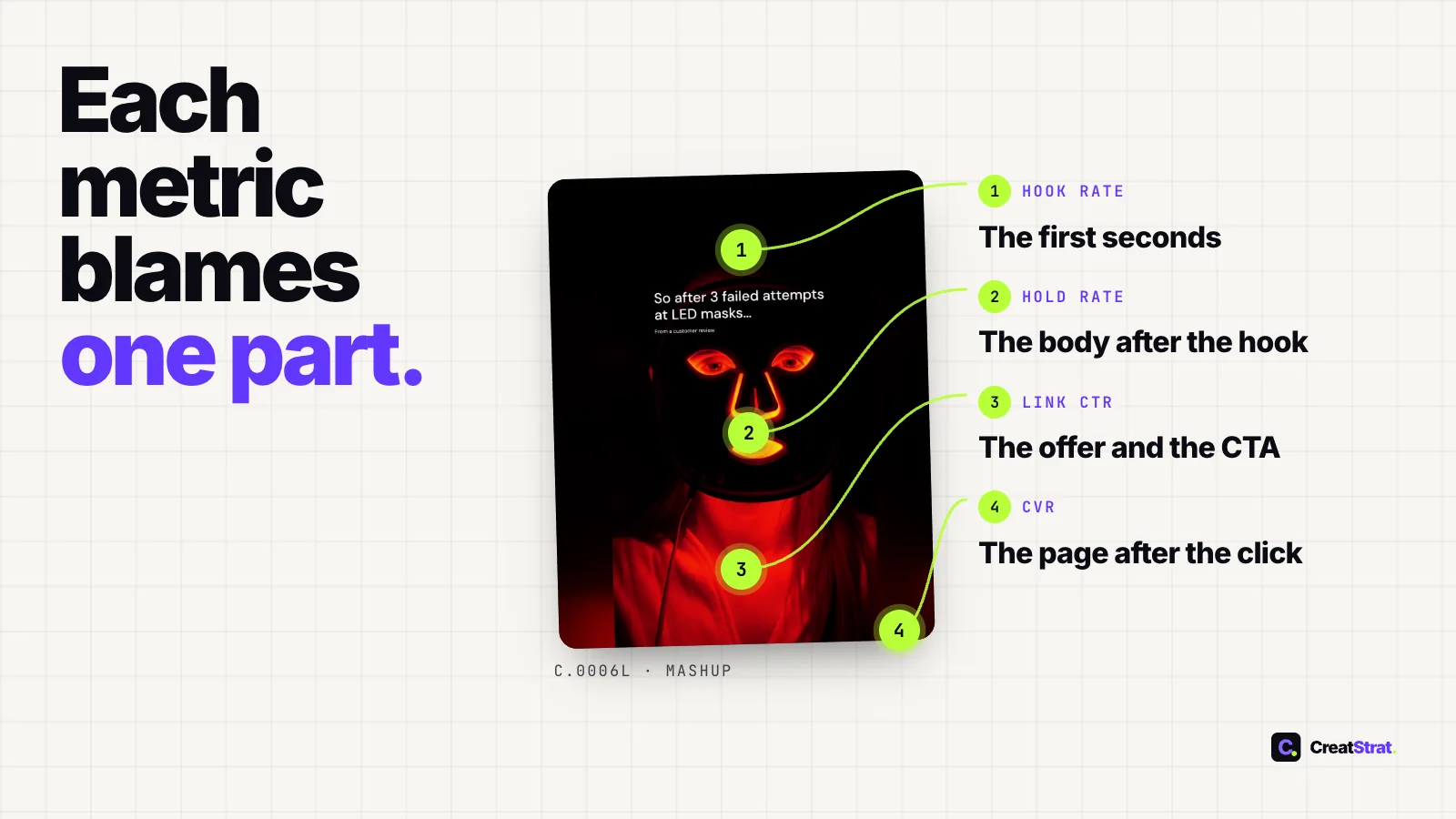
So when someone tells you "the hook is weak" or "CTR is low," you know the creative is being blamed but not which part of it. Each metric points at a different part of the ad: the first seconds, the body, the offer and CTA, or the landing page. The table below maps each one to the part it blames and the change it calls for in the next brief.
- 1The first seconds Hook rate
Opening frame, first line, first motion. An industry formula, usually 3-second video plays ÷ impressions.
- 2The body Hold rate
Pacing, proof, the story after the hook. An industry formula; CreatStrat recommends plays at 50% of length ÷ 3-second plays.
- 3The offer and CTA Link CTR
Whether the ad's promise earns a click. Meta-defined: read link CTR or outbound CTR, not CTR (all).
- 4The landing page CVR
Whether the page keeps the ad's promise. Advertiser-built, usually purchases ÷ link clicks.
What is hook rate (and what is it not)?
Hook rate, also called thumbstop ratio, is a metric the ad industry coined. According to Meta's Marketing API reference (Meta for Developers, "Marketing API reference: Ad Account Insights (Graph API v25.0)", accessed October 2, 2026), Meta's ad insights fields include nothing named or described as hook rate, hold rate or thumbstop, and no field that reports the conversion rate you'd calculate yourself (purchases ÷ link clicks). With no hook-rate field to pull, you build it in a spreadsheet export, or as a custom metric if your Ads Manager offers one.
Hook rate is an industry metric, not a Meta one: it is usually short-view video plays divided by impressions, and it measures the first seconds of the ad.
The usual numerator is the 3-second video plays column. Before you compare your hook rate with anyone else's, check in your own Ads Manager what that column counts, and whether they used the same column and the same denominator.
It measures something narrow: the opening frame, the first line on screen or in the voiceover, the first movement. A high hook rate means people stopped scrolling. It says nothing about whether they wanted the product.
Static image ads have no hook rate or hold rate, since there's no video play to count. Link CTR and conversion rate carry their diagnosis.
Which part of your ad does each metric blame?
This table is a CreatStrat framework for reading results, not a Meta rule. CVR in it means purchases divided by link clicks. Some teams divide by landing page views instead, which gives a different number from the same account.
Each metric points at a different part of a Meta ad: hook rate at the opening seconds, hold rate at the body, link CTR at the offer and CTA, and conversion rate at the landing page and offer match.
| Metric | Defined by | Part of the ad it points at | What to change in the next brief |
|---|---|---|---|
| Hook rate | Industry formula | The first seconds: opening frame, first line, first motion | Write a new hook onto the same body |
| Hold rate | Industry formula | The body: pacing, proof, the story after the hook | Keep the hook; re-cut or rescript the body |
| CTR (all) | Meta | Any click on the ad, including clicks that don't head to your site | Nothing on its own. Read it as a sanity check |
| Link CTR / outbound CTR | Meta | The offer, the CTA, and whether the ad's promise earns a click | A new angle, offer framing or CTA. For statics: the headline and Meta copy |
| CVR (purchases ÷ link clicks) | Advertiser-built | The landing page and whether it matches the offer, more than the ad | Check that the page keeps the ad's promise before you blame the creative |
Static ads skip the first two rows.
The right-hand column only helps once it's written into the next brief. Here is what goes in a production-ready ad brief.
Once the table says "new hook" or "new angle," someone still has to brief the next ads and produce them. On a CreatStrat plan, that kind of change is what the weekly Iterate job turns into a finished ad with its brief, and the plan learns from connected results. The Gap Scan shows what to test first.
Free. 3 researched opportunities, 1 customer-avatar gap, and 1 example concept within 24 hours.
How do you read hook rate and hold rate in Ads Manager?
You build both in a spreadsheet export, or as custom metrics if your Ads Manager offers them.
Hold rate is where the formulas split. Divide a long-view column by impressions and the hook leaks back in: a weak opening drags hold rate down even if everyone who stayed watched to the end. Divide by 3-second plays and the question gets cleaner. Of the people the hook stopped, how many did the body keep?
Hold rate is an industry formula that Meta doesn't define, so the same ad can show different hold rates depending on whether you divide by short-view plays or by impressions.
CreatStrat recommends building the numerator from Meta's percent-watched metrics, because Meta defines them. According to Meta's Marketing API reference (Meta for Developers, "Marketing API reference: Ad Account Insights (Graph API v25.0)", accessed October 2, 2026), the 25% field counts "the number of times your video was played at 25% of its length, including plays that skipped to this point," and the 50% and 75% fields read the same way. Plays at 50% divided by 3-second plays describes the body with the hook already filtered out.
Two caveats follow from Meta's wording. Skips count, so someone who scrubs to the halfway point counts as a play at 50%. And the marks are shares of length: halfway through a 12-second ad and halfway through a 45-second ad are different moments. Compare ads of similar length, or read the 25%, 50% and 75% columns side by side as a drop-off curve.
Compare hook and hold within the same ad set and placement, so the ad is the only thing that differs.
Which CTR should you look at: CTR (all), link CTR or outbound CTR?
Meta reports more than one click-through rate, and they don't count the same clicks. Three matter for reading an ad.
According to Meta's Marketing API reference (Meta for Developers, "Marketing API reference: Ad Account Insights (Graph API v25.0)", accessed October 2, 2026), CTR counts a click (all), link CTR counts an inline link click, and outbound CTR counts clicks that take people off Facebook-owned properties.
| CTR variant | What Meta says it counts | When to use it |
|---|---|---|
| CTR (all) | "The percentage of times Accounts Center accounts saw your ad and performed a click (all)." | A sanity check only |
| Link CTR | Inline link clicks: "clicks on links to select destinations or experiences, on or off Facebook-owned properties." | Offer response when some destinations sit inside Meta's apps |
| Outbound CTR | Outbound clicks: "clicks on links that take Accounts Center accounts off Facebook-owned properties." | Offer response when the ad sends people to your own site |
Meta's description of CTR (all) stops at "a click (all)" and doesn't list what "all" contains. It counts more than link clicks, though, so it can look healthy while link CTR is weak. To judge whether the offer earns a click, read link CTR or outbound CTR and keep the same one across a comparison.
Why is your CVR different from the one in someone else's report?
According to Meta's Marketing API reference (Meta for Developers, "Marketing API reference: Ad Account Insights (Graph API v25.0)", accessed October 2, 2026), Meta's ad insights have no field that reports the conversion rate you'd calculate yourself (purchases ÷ link clicks). CVR is advertiser-built, usually purchases divided by link clicks or by landing page views, so two people reading the same account can report different CVRs for the same ad and both be right.
According to Meta (Meta for Business, "Simplifying Ad Measurement for a Social-First World", March 3, 2026), click-through attribution for website and in-store conversions now counts link clicks only, so a conversion rate built from Meta-attributed purchases can shift without the ad changing.
In Meta's words, it is "changing the definition of click-through attribution for website and in-store conversions to exclusively include link clicks" (Meta for Business, "Simplifying Ad Measurement for a Social-First World", March 3, 2026). According to the same Meta post, the engaged view for a video ad also went from 10 seconds to 5 seconds, and billing doesn't change. If your CVR trend steps up or down around when that change reached your account, check attribution before you rewrite the ad.
A strong link CTR with a weak CVR points first at the landing page, because the ad already earned the click. Check that the page keeps the ad's promise (the same offer, the same product, a headline that picks up the hook) before you brief a new angle.
Read CVR at enough volume, too. On a small number of purchases one sale moves it a long way, and why an ad with 9 purchases isn't a winner shows the arithmetic.
Why do published hook-rate benchmarks disagree?
Search for a good hook rate and you'll find confident numbers that don't agree. They aren't measuring the same thing.
Published hook-rate benchmarks disagree because they divide by different things, mix Reels with feed placements, and mix cold with warm audiences.
Start with the denominator. Hold rate alone has at least three versions in use, and long-view plays over impressions can't sit beside 50% plays over 3-second plays. Placement comes next: a figure pooled across Reels and feed describes that mix, and your account runs a different one. Then audience temperature. People who already know a brand are a different audience from people meeting it for the first time, and a benchmark that pools both describes neither.
So this post gives no benchmark. A number without its formula, placement and audience can't be compared with yours. Compare your own ads with each other instead: same placement, same audience, same date range, enough volume to mean something. How many tries it takes before one wins is its own topic: how many ads it takes to find a winner.
If the same ad's hook rate slides week over week on the same audience, check frequency before you rewrite the hook. A worn-out ad is a different problem, and here is why fatigue is a supply problem.
What do the patterns tell you to change next?
One metric gives you a symptom. Read together, they give you a brief.
- Hook rate weak, hold rate fine: keep the body and brief new openings onto it.
- Hook rate fine, hold rate weak: keep the hook, then re-cut or rescript the body (pacing, when the proof arrives, what follows the first line).
- Link CTR weak across several hooks: the hooks aren't the issue. This points at the angle, offer framing or CTA, so the next brief tries a new angle.
- Link CTR strong, CVR weak: check the landing page against the ad's promise before you change the creative.
- Everything looks fine but the counts are small: there's no pattern yet. Keep the ads running and read them again at volume.
Statics follow the same logic from item three down. Link CTR and CVR carry the diagnosis, and the image, headline and Meta copy are what you change.
Every item on that list ends in a brief, and every brief ends in an ad someone has to make. CreatStrat is a software subscription that delivers finished ads every week. CreatStrat researches, plans the tests, writes the brief, and produces the finished statics, carousels, mashups, AI video, and AI UGC, each with its Meta copy. Your creative strategist is built in. Through a read-only Meta connection, it learns from connected results to plan the next batch. CreatStrat delivers the finished ads and briefs; you still run them in your own Meta account. For the shape of that week, see what a Monday creative plan looks like.
Our media buyer used to tell us we needed more creative. CreatStrat closed that gap. Now we get a clear testing strategy, the reasoning behind every concept, and the actual ads ready to launch. It feels like we added a creative strategy team without actually hiring one.
 Marcus B. · CreatStrat customer
Frequently asked questions
How is hook rate calculated? Hook rate is usually 3-second video plays divided by impressions, an industry formula rather than a Meta metric. Build it in a spreadsheet export, or as a custom metric if your Ads Manager offers one. Check in your account what the plays column counts.
What is the difference between hook rate and hold rate? Hook rate measures the opening seconds of a video ad. Hold rate measures how much of the body keeps people watching after the hook. Meta defines neither, so state your formula, including the denominator, whenever you compare them.
What is a good hook rate for Meta ads? No single number holds up. Published figures divide by different things and mix placements and audience temperatures. Compare your own ads against each other, in the same placement and audience over the same dates, with enough volume to read.
What does CTR (all) include? According to Meta's Marketing API reference (Meta for Developers, "Marketing API reference: Ad Account Insights (Graph API v25.0)", accessed October 2, 2026), CTR (all) is the percentage of times people saw your ad and performed "a click (all)." Meta doesn't list the interactions inside "all," so use link CTR or outbound CTR to judge offer response.
Does Meta report conversion rate? Not as a rate. According to Meta's Marketing API reference (Meta for Developers, "Marketing API reference: Ad Account Insights (Graph API v25.0)", accessed October 2, 2026), its ad insights have no field that reports the conversion rate you'd calculate (purchases ÷ link clicks). You build CVR yourself, usually purchases divided by link clicks or by landing page views, so two CVRs from one account can disagree.
Why is my CTR high but I get no sales? First check that it's link CTR that's high, not CTR (all). A strong link CTR with weak sales points at the landing page and whether it keeps the ad's promise. Check the page's headline, offer and product against the ad before you brief a new angle.
Start the next brief from a reason
A red column tells you where to look. The Gap Scan gives the next brief a reason to exist.
Free. 3 researched opportunities, 1 customer-avatar gap, and 1 example concept within 24 hours.
Want to see the app first? Book a demo →
Sources
- Meta for Developers. 2026. Marketing API reference: Ad Account Insights (Graph API v25.0). https://developers.facebook.com/documentation/ads-commerce/marketing-api/reference/ad-account/insights. Read 2026-10-02.
- Meta for Business. 2026 (March 3). Simplifying Ad Measurement for a Social-First World. https://www.facebook.com/business/news/click-attribution. Read 2026-10-02.