It is Monday. There are eleven half-briefed ideas in a doc somewhere, an editor waiting on direction, and a dashboard you have already opened twice before coffee. You are not confused about what creative strategy is. You are just carrying all of it in your head at once.
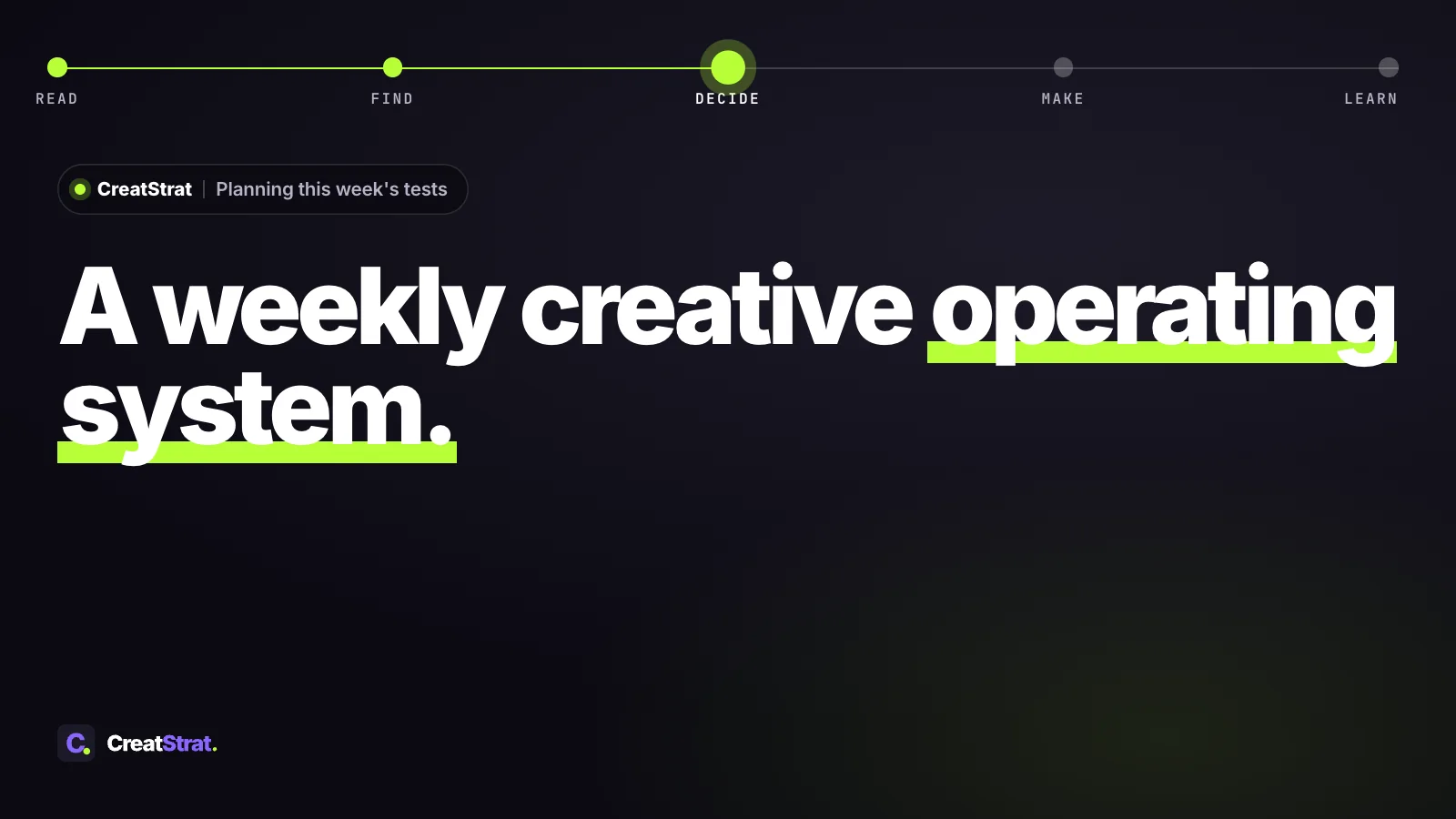
The fix is not more ideas. It is a calendar. A weekly creative operating system puts each job on a fixed day so you stop deciding when to decide. This page names the calendar, day by day, and gives the reason each day sits where it does.
- MondayDecision day
Research, then brief in writing
briefs handed over
- Tue to ThuProduction days
Craft only, no account edits
assets finished, launches queued
- FridayReading and writing day
Closed results, written down
one written note per concept
- Next MondayThe loop closes
Friday's note is the input
starts from evidence
What is the weekly creative operating system?
A weekly creative operating system is a fixed calendar that separates three jobs, research, brief, and learn, onto different days, so each one gets done with the right information instead of being rushed inside a single meeting. It is a schedule, not a mindset. If it does not appear on a calendar, it is not a system yet.
The three jobs have a plain name: Research. Brief. Learn. Repeat. Research is deciding what should be made. Briefing is defining exactly what is being made. Learning is reading what last week's ads actually said and writing it down. Most teams collapse all three into one meeting, and the learning step is the one that quietly gets dropped, because it is the only one with no deadline attached.
The stakes are not small. Creative quality contributes as much to a brand's in-market success as all other factors combined, according to Nielsen chief neuroscientist Carl Marci, writing for Nielsen Insights in 2017. The work of deciding what to make is not overhead sitting next to the media buying. It is most of the job.
That is also why the loop is a cadence rather than a project. This post is the calendar view. For the role itself, see what a creative strategist actually does.
The weekly creative calendar: what happens each day
Here is the whole week on one screen. Copy it into your own calendar as four recurring blocks and the rest of this article explains why each one is where it is.
The weekly loop has three jobs, research, brief, and learn, and they belong on different days: Monday for the decision, Tuesday through Thursday for production, and Friday for reading and writing down what closed signals actually said.
| Day | Input read | Decision made | Output shipped |
|---|---|---|---|
| Monday Plan and brief |
Last week's closed results, Friday's written learning, the current concept backlog, competitor and customer research | What to make next, and what stops | The week's briefs, written and handed to production. This is where what a production-ready brief actually contains matters most |
| Tuesday to Thursday Production only |
The briefs. Nothing else | Craft decisions only: casting, edit, pacing, art direction | Finished assets, plus next week's launches queued. The ad account is not edited |
| Friday Read and write |
Closed results from concepts that have finished their attribution window | What each concept was testing, and what happened, including the failures | One written learning note per concept. It is a document, not a memory |
| Following Monday The loop closes |
Friday's note, read as an input | Whether the next round iterates on the concept or replaces it | The next week's briefs, now informed rather than invented |
Four things make this shape work.
The decision is separated from the data. Monday is the only day a strategic decision gets made, and it is made from numbers that have finished settling rather than from a live dashboard.
Production gets an uninterrupted lane. Once briefs are handed over, midweek belongs to craft. There is no strategic re-litigating on Wednesday, and there is nothing to edit in the ad account.
Learning gets a slot of its own. Friday is not a performance check. It ends in writing, which is the step that survives staff changes and slow months.
The loop repeats because creative wears out. That is not a vibe. A 2015 meta-analysis in the Journal of Advertising by Schmidt and Eisend found that maximum attitude toward the brand is reached at approximately ten exposures, with both attitude and recall degrading over time. Wearout is real and reasonably predictable, which is exactly what makes a fixed replenishment cadence possible.
One thing this calendar deliberately does not tell you is how many concepts belong in a week. That number depends on your budget and the size of your team more than on any universal rule, and the figures circulating in this category contradict each other with nothing underneath them. It gets its own post: how many creative concepts you should test each week.
The Monday row runs on customer and competitor research, and the Gap Scan runs a first pass of it on your product page.
Free. 3 researched opportunities, 1 customer-avatar gap, and 1 example concept within 24 hours.
Monday is the decision day, not the busy day
Most operators reading this already have a daily habit: open Ads Manager, scan yesterday, adjust something. That habit is what the calendar replaces, and replacing it is the single biggest change here.
How often should you review ad creative performance?
Review ad creative performance on a fixed weekly day, not daily. Meta's own conversion attribution documentation (Marketing API documentation, "Ad Set Reference") describes multi-day attribution windows, so a mid-week read is measuring a week that has not finished yet.
The reasoning is in the platform's own reference material. Per Meta's Marketing API documentation ("Ad Set Reference"), attribution_spec is the conversion attribution spec used for attributing conversions for optimization, supported window lengths differ by optimization goal and campaign objective, and those windows are expressed in days. A conversion that happens today can attach to an impression from several days ago. Read a campaign on Wednesday and you are reading a partial ledger, then making a decision as if it were complete.
To be clear about scope: this is not budget or bidding advice. Attribution windows appear here for exactly one reason, to explain why the reading day sits where it sits.
So Monday reads last week, closed. Two decisions come out of it. The first is what to make next, which usually resolves into either a new angle for an audience you are not speaking to, or a genuinely different execution of an angle that already works. Those are different problems: see where audience gaps come from and how distinct your concepts actually are.
The second decision is what actually ships as briefs this week. Not concepts, not moodboards. Briefs, written, with hooks, script, format, and direction, handed to whoever is producing. If Monday ends without briefs in someone's hands, Monday did not happen.
Tuesday to Thursday: why the account stays untouched
Midweek is production only. Nothing gets edited in the ad account, and the strategy conversation stays closed until the following Monday.
This is the rule people push back on hardest, and it is the one with the clearest documentation behind it.
Does editing an ad reset the learning phase?
Yes. Meta's Marketing API documentation ("Ad Campaign Learning Stage Info") defines a last_sig_edit_ts field, the timestamp an ad set re-entered the learning phase after a significant edit, and while an ad set is learning, delivery performance may be unstable.
The same reference documents learning_stage_info as information on whether the ranking or delivery system is still learning for an ad set, with status values of LEARNING, SUCCESS, and FAIL, where FAIL describes an ad set that never got enough results to exit learning at all. Meta's documentation does not publish a numeric event threshold, and you should be suspicious of any page that quotes one without a primary source.
What matters for your week is the mechanism, not a threshold number. Tinkering has a documented cost. Every significant edit restarts a clock, which means a Wednesday adjustment made from incomplete data can push the ad set back into an unstable delivery period, and Friday's read then measures the edit rather than the creative.
So the discipline is not willpower and it is not a personality trait. It is a mechanical decision you make once, on the calendar, so you do not have to make it again at 9am on Wednesday when a number looks bad.
One clarification, because midweek restraint gets misread: this applies to the ad account, not to your work. Production runs hard Tuesday through Thursday. Observation is allowed. Intervention is not.
Friday is the reading day, and it ends in writing
Friday has two halves, and almost every team does the first and skips the second.
When should you decide if an ad is a winner?
Decide only after a concept's attribution window has closed, on your fixed weekly reading day, and expect most weeks to produce no winner at all.
Most weeks will not produce a winner, and that is the expected outcome, not a bad week. Evaluating well-designed and executed experiments that were designed to improve a key metric, only about one-third were successful at improving the key metric, according to a 2009 case study of Microsoft's Experimentation Platform by Kohavi, Crook and Longbotham.
That finding comes from a team running online experiments at enormous scale with dedicated statisticians. If two in three of their well-designed tests did not move the metric they targeted, a creative cadence built on the assumption that most concepts will not win is built correctly. One that expects a winner every week is not, and it will burn out the people running it. Whether a result is real at all is its own discipline: how to tell if an ad actually won.
How do you document creative learnings?
Write one short note per concept on the same day every week, recording what the concept was testing, what the closed numbers said, and what happens to it next. Keep the failures. A learning log is only useful if it contains the things that did not work.
The note does not need a template committee. Three lines is enough.
> Illustrative example, written by the reader's own team: > Concept: founder explains the reformulation. Talking head, problem-aware audience. > What it was testing: whether naming the old formula's flaw earns trust faster than leading with a benefit list. > What happened, and what's next: held attention well past the hook, did not convert like the reference concept. Keep the hook, replace the back half with the demo, rebrief Monday.
This is also the step where creative fatigue stops being a surprise. When you have a written record of when each concept launched and how it aged, replenishment becomes a scheduling problem rather than an emergency: creative fatigue is a supply problem.
Why the learning has to be written down
Teams that start every Monday from scratch are not lazy or slow. They have no organizational memory. The idea is well established in management research: Walsh and Ungson's 1991 paper in The Academy of Management Review set out organizational memory as knowledge retained by the organization itself rather than by whichever individual happens to remember it. If your account's learnings live only in a growth lead's head, they leave when that person does, and in practice they leave much earlier than that, usually around week three.
Founder explains the reformulation. Talking head, problem-aware audience.
Whether naming the old formula's flaw earns trust faster than leading with a benefit list.
Held attention well past the hook. Did not convert like the reference concept. Keep the hook, replace the back half with the demo, rebrief Monday.
Informed rather than invented. Every note stays in the log.
One note does not change a quarter. Fifty notes change what Monday feels like, because you start from evidence.
The measured version of this point is encouraging. According to a 2022 study in Management Science by Koning, Hasan and Chatterji, performance improves by 30% to 100% after a year of use among firms that adopt A/B testing, and the authors credit the broader strategy of experimentation rather than any single test. Read that carefully, because the emphasis is the whole argument. The gain in that research is attributed to the accumulated practice, not to one clever test. That is third-party research about experimentation in general, not a result any tool can promise you, and results vary by team and market.
Marketing research frames this the same way. Kalaignanam and colleagues, writing in the Journal of Marketing in 2021, treat marketing agility as an organizational capability rather than an individual trait. Short, repeated decision cycles are something a team builds deliberately. They are not something a fast person supplies by working weekends.
So the honest pitch for Friday's twenty minutes of writing is not that any single note will change your quarter. It is that fifty notes will change what Monday feels like, because you will be starting from evidence instead of from a blank document.
How small can the team be and still run this?
One person can run this loop. That is the honest answer, and it comes with an equally honest caveat: the research and briefing half is roughly a day of work a week, and it is a day most small DTC teams do not have spare.
The two halves of the week are not equally expensive. Production is production. Your editor edits, your designer designs, and that work exists whether or not there is a system around it. The research and briefing half is the part that gets squeezed, because it has no artifact until you make one and no client waiting on it. It is the first thing that disappears in a launch week, and once it disappears, Monday stops being a decision and becomes a scramble.
That is the real trade-off. Not "should we have a process," but "who is doing Monday." If the answer is "the founder, sometimes, after standup," the cadence will hold for about three weeks.
Where CreatStrat fits in the loop
CreatStrat is an automated creative strategy product, and it runs this loop, production included.
It researches your brand, your customers, your market, and your connected ad performance, decides what the week tests, and writes a brief for every ad: the opportunity and why it matters now, hooks written word for word, the script or layout with production direction, the awareness stage, format, and audience, plus what the ad tests. That is the Monday row of the table above. Then it makes the ads, which is the Tuesday-to-Thursday row: the statics, carousels, mashups, AI videos, and AI UGC videos in your weekly mix, each delivered with its brief and Meta copy.
Your week becomes launching the finished batch and leaving the account alone while it runs.
The Friday step is automatic. The Meta connection is read-only, view performance only, and you never send us your results. Last week's connected performance shapes next week's plan, which is the compounding effect described above, running without anyone remembering to do it on a Friday afternoon. Steering is optional: add a note when you want to, and the next batch is planned either way.
To see the Monday half of that thinking on your own brand first, start with a free Gap Scan.
FAQ
What does a creative strategist do each week?
They run a fixed loop. Research what to make on Monday, brief it in writing the same day, let production run midweek without touching the ad account, then read closed results and document what happened on Friday. The loop repeats weekly, and each week's learning feeds the next.
How often should you review ad creative performance?
On a fixed weekly day, not daily. Meta's conversion attribution runs on multi-day windows, so checking performance midweek measures a week that has not closed yet. Read closed numbers once, on the same day every week, and make decisions only then.
Does editing an ad reset the learning phase?
Yes. Meta's Marketing API documentation ("Ad Campaign Learning Stage Info") defines a field, last_sig_edit_ts, for the moment an ad set re-enters the learning phase after a significant edit. While an ad set is learning, delivery performance may be unstable, which is why midweek tinkering costs more than it appears to.
How many creatives should I test per week?
It depends on your budget and team size more than on any fixed rule, and most published numbers in this category contradict each other with no source behind them. A dedicated post resolves this by spend tier.
What is creative fatigue and how do you spot it?
Creative fatigue is a supply problem before it is a detection problem. Concepts wear out on a reasonably predictable clock, and the fix is having enough new concepts ready rather than noticing the decline a few days sooner.
What should be in a weekly creative meeting?
Three things. What last week's closed results actually said, what ships as briefs this week, and one written record of what was tested and what was learned. Skipping the written record is the most common failure mode, because it is the only item with no external deadline.
The calendar is the system
You now have the week: Monday decides and briefs, Tuesday through Thursday produces without touching the account, Friday reads closed results and writes them down, and the following Monday starts from that note instead of from nothing. Research. Brief. Learn. Repeat. Every day in it has a reason, and the reasons come from Meta's own documentation and from published research rather than from someone's opinion about cadence.
The part most small teams cannot staff is the research and briefing half of Monday, and the production lane behind it.
See what the research finds on your product. Share a product page URL and email. Within 24 hours we’ll send 3 researched opportunities, 1 customer-avatar gap, and 1 example concept.
Want to see the app first? Book a demo →
Sources
- Koning, R., Hasan, S., & Chatterji, A. 2022. Experimentation and Start-up Performance: Evidence from A/B Testing. Management Science. 68(9):6434-6453. doi:10.1287/mnsc.2021.4209.
- Kohavi, R., Crook, T., & Longbotham, R. 2009. Online Experimentation at Microsoft. Third Workshop on Data Mining Case Studies and Practice Prize, 15th ACM SIGKDD International Conference on Knowledge Discovery and Data Mining (KDD 2009). Microsoft Experimentation Platform, Redmond, WA. https://exp-platform.com/Documents/ExP_DMCaseStudies.pdf
- Walsh, J. P., & Ungson, G. R. 1991. Organizational Memory. The Academy of Management Review. 16(1):57-91. doi:10.2307/258607.
- Schmidt, S., & Eisend, M. 2015. Advertising Repetition: A Meta-Analysis on Effective Frequency in Advertising. Journal of Advertising. 44(4):415-428. doi:10.1080/00913367.2015.1018460.
- Kalaignanam, K., Tuli, K. R., Kushwaha, T., Lee, L., & Gal, D. 2021. Marketing Agility: The Concept, Antecedents, and a Research Agenda. Journal of Marketing. 85(1):35-58. doi:10.1177/0022242920952760.
- Meta Platforms, Inc. Ad Campaign Learning Stage Info (Graph API Reference). Marketing API documentation. https://developers.facebook.com/docs/marketing-api/reference/ad-campaign-learning-stage-info/
- Meta Platforms, Inc. Ad Set Reference (
attribution_spec,learning_stage_info). Marketing API documentation. https://developers.facebook.com/docs/marketing-api/reference/ad-campaign/ - Marci, C. (Chief Neuroscientist, Nielsen). 2017. Perspectives: Want a Successful Ad? Get Creative. Nielsen Insights. https://www.nielsen.com/insights/2017/perspectives-want-a-successful-ad-get-creative/